The King’s Gambit
As we just mentioned, White would like to play d4, to have two pawns in the centre, controlling four central squares:
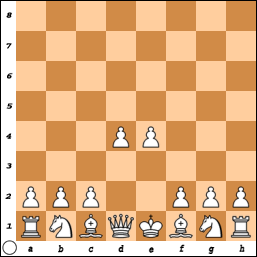
However,
1. e4 e5
2. d4
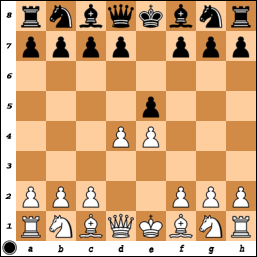
will probably be met with:
2. … e × d4
(meaning that Black’s e pawn captures White’s pawn on d4.)
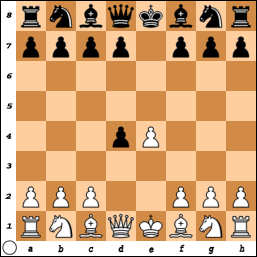
3. Q × d4
but after:
3. … Nc6
the Queen will have to move:
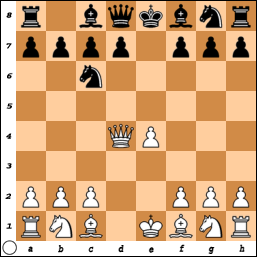
Notice how Black has developed a Knight – and onto a good square – whilst White has to waste time moving the Queen a second time.
In the King’s Gambit, White tries to move Black’s pawn away from e5.
This is done by playing:
2. f4
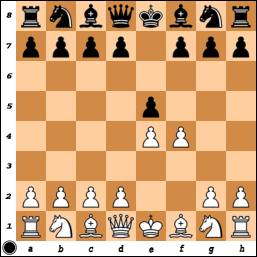
This is the gambit – White offers Black this f-pawn for free.
In exchange, White hopes to be able to play d4.
Black does not have to accept the offered pawn – it is thought that it is better to accept than reject so we will assume that Black now plays:
2. … e × f4
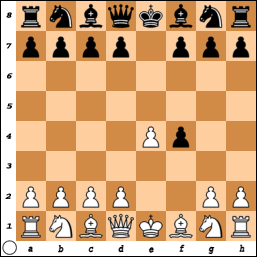
This the King’s Gambit Accepted (C33).
(According to 365chess.com, White wins 44% of games now, Black 37% with 19% drawn. From 1. e4 the chances are 38%, 32% and 30% so we have a better chance of a decisive game.)
Can White play 3. d4 now?
The problem with 2. f4 is that it opens the diagonal e1 – h4:
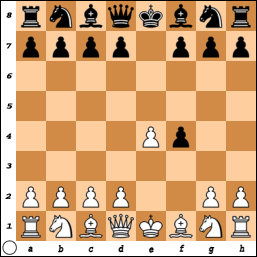
So 3. d4 can be met by 3. … Qh4+:
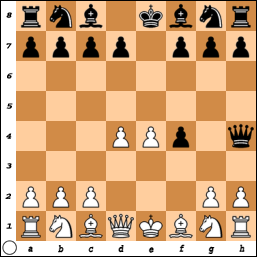
White has problems. d4 has to wait.
We are going to look at:
3. Nf3
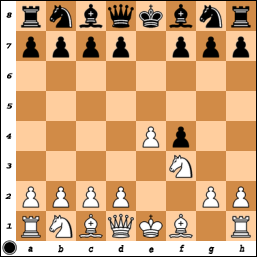
Notice how the Knight blocks the forward progress of the Black pawn.
It also covers that h4 square – Black can longer play Qh4+ as the Knight will simply capture the Queen.
Black typically plays:
3. … g5
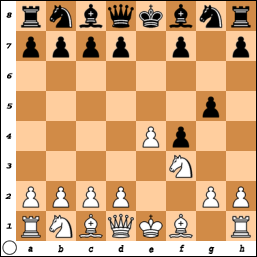
As well as defending the pawn on f4, this also threatens g4, attacking the Knight.
White responds with:
4. h4
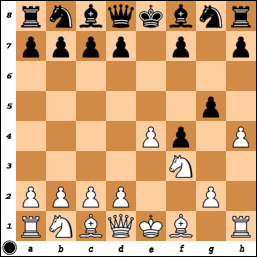
This threatens the pawn on g5 so Black pushes it forward:
4. … g4
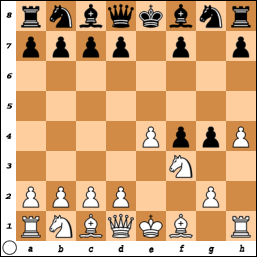
Black threatens g × f3, so White will have to move the Knight.
We suppose that White plays:
5. Ne5
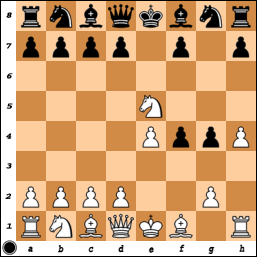
This is the Kieseritzky Gambit.
White’s Knight is now attacking the Black’s weak pawn on f7 (it is only defended by the King) and also attacking the pawn on g4.
We expect Black to defend this pawn with:
5. … Nf6
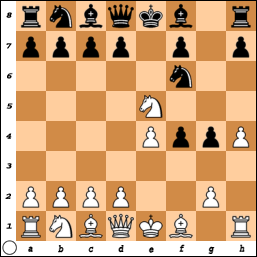
Now White can play d4:
6. d4
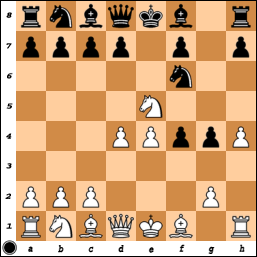
This is the point reached at move 6 in the sample game – between two players who would in turn become World Champion.
Sample game
White: Boris Spassky
Black: Bobby Fischer
30th March 1960, Mar del Plata
King’s Gambit Accepted, C39
1. e4 e5
2. f4 exf4
3. Nf3 g5
4. h4 g4
5. Ne5 Nf6
6. d4 d6
7. Nd3 Nxe4
8. Bxf4 Bg7
9. Nc3 Nxc3
10. bxc3 c5
11. Be2 cxd4
12. O-O Nc6
13. Bxg4 O-O
14. Bxc8 Rxc8
15. Qg4 f5
16. Qg3 dxc3
17. Rae1 Kh8
18. Kh1 Rg8
19. Bxd6 Bf8
20. Be5+ Nxe5
21. Qxe5+ Rg7
22. Rxf5 Qxh4+
23. Kg1 Qg4
24. Rf2 Be7
25. Re4 Qg5
26. Qd4 Rf8
27. Re5 Rd8
28. Qe4 Qh4
29. Rf4
1-0
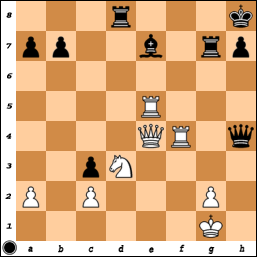
Why did Fischer resign here?
The Bishop is lost – the Queen must move to avoid being captured by the Rook on f4 and she cannot safely move to g5 or f6. So she has to move off the h4 – f6 diagonal so she is no longer defending the Bishop.
Then R × e7, R × e7; Q × e7 and White has the Bishop and a Rook for a Rook.
The material advantage for White is then too great.
The King’s Gambit Declined
We have looked at the King’s Gambit Accepted.
This followed the moves:
1. e4 e5
2. f4
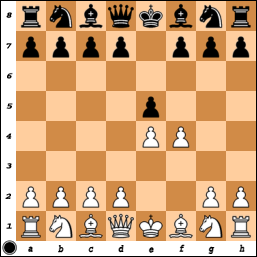
This is the gambit – White offers Black this f-pawn for free.
In exchange, White hopes to be able to play d4.
Black does not have to accept the offered pawn.
What are the options?
2. … Bc5
is the Classical Defence (C30):
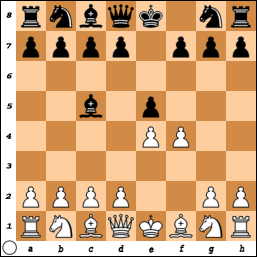
Notice that this Bishop acting along the c5 to g1 diagonal prevents White from castling kingside – the King would end up in check.
Surely this allows White to capture Black’s e-pawn for free:
3. f × e5
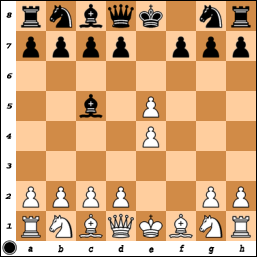
Black should reply:
3. … Qh4+
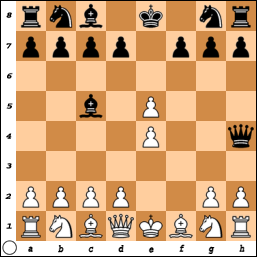
White has two options:
a) block the check with 4. g3:
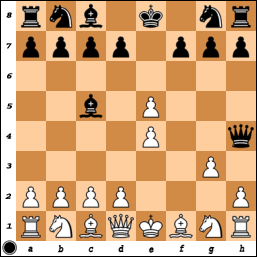
but Black responds with 4. … Q × e4+:
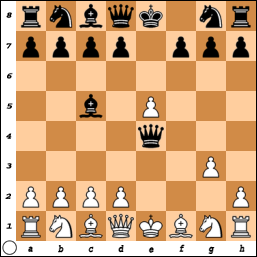
Whatever White does, 5. … Q × h1 and White is a Rook down with the kingside in disarray.
b) move out of check with 4. Ke2:
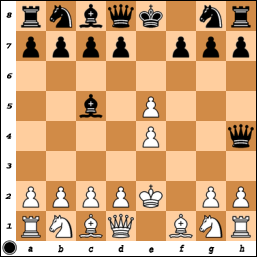
Now 4. … Q × e5#:
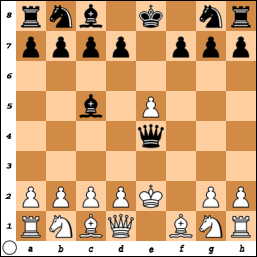
A disaster for White.
So Black’s e-pawn is safe for the moment.
Both sides continue with developing moves, perhaps:
3. Nf3 d6
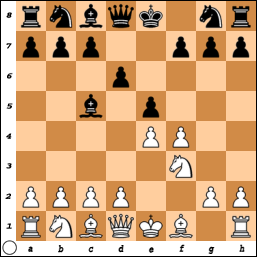
Followed by:
4. Nc3 Nf6
5. Bc4 Nc6
6. d3
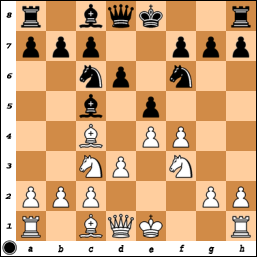
Both sides have chances here – White has a greater presence in the centre with that pawn on f4, but is prevented from castling kingside by Black’s Bishop on c5 attacking g1, the King’s destination. White: 44%, Black: 33%, Draw: 24% (≠ 100% – rounding errors).
White will probably aim to play Na4 with the aim of exchanging that troublesome Bishop.
Black’s other option is to play a gambit themselves:
2. … d5
This is the Falkbeer Countergambit (C31):
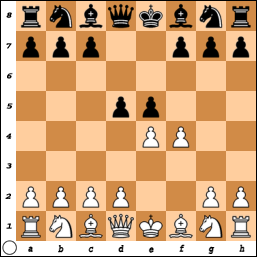
As we have already seen, 3. f × e4 fails after 3. … Qh4+ so Black’s e-pawn is safe.
White can capture the d-pawn:
3. e × d5
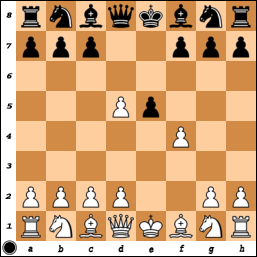
Now:
3. … e4 looks troublesome:
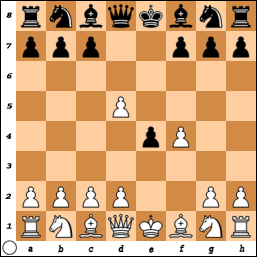
but:
4. d3 gives White the advantage:
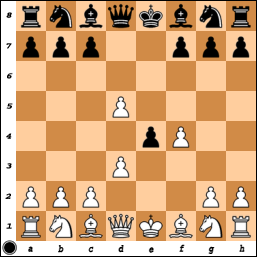
According to 365chess, chances are 49% White, 28% Black 23% Draw.
Black’s most popular response is 4. … Nf6, but after 5. d × e4 White’s chances are 54%.
The Falkbeer has – unsurprisingly perhaps – fallen out of favour.
Both rejections offer slightly worse chances for Black than acceptance:
2. … e × f4: White 44% Black 37% Draw 19%
2. … Bc5: White 44% Black 36% Draw 21% (≠ 100%)
2. … d5: White 43% Black 35% Draw 22%